The MergeOn Platform
The enterprise foundation for building, governing and operating AI at scale.
Explore the platform →THEMIS Mission Control NewUnderstand what is changing across your organization and bring the right decisions to the right people at the right time.
Runtime Digital Twin PreviewVisualize every runtime, capability and relationship across your AI operating environment.
Create governed AI activity once, with its knowledge, controls, approvals and execution requirements.
Runtime CenterOperate and observe governed Runtimes, activity, execution, evidence and readiness from one operational surface.
Governed KnowledgeTurn enterprise information into structured, governed context that AI can use without losing source meaning and relationships.
Policy & ProtectionDefine the controls that govern what AI may access, what it may do, what must be protected and when a person must approve.
Data ProtectionProtect sensitive values while preserving the business context AI needs to perform the governed task.
Human ApprovalRequire human authority where governed AI activity should not proceed on AI authority alone.
Golden ThreadReconstruct governed AI execution from request to outcome with connected execution evidence.
AI Evaluation & AssuranceVerify what can be proven, evaluate AI behaviour and establish evidence-backed readiness in context.
AI Model GovernanceGovern which models may participate, where they may be used, what evidence supports them and when their qualification must be reconsidered.
Why MergeOn
Turn the knowledge you already have into governed context AI can use.
Policies, procedures, manuals, regulations and operating documents were written for people — not AI.
MergeOn Document Intelligence transforms them into structured Tier-3 Review Packs, preserving meaning, relationships, dependencies and source context. Accepted knowledge can then be governed in the Knowledge Center and supplied to AI at execution.
Better context. Less repeated processing. More efficient AI execution.
Explore Governed Knowledge →Wherever critical knowledge, policy and AI execution have to work together.
Govern policies, controls, product rules and regulated decisions while keeping AI execution traceable.
Healthcare & Life SciencesTurn clinical, operational and regulatory knowledge into governed context while protecting sensitive information.
Logistics & Supply ChainStructure customs, trade, food, agriculture, transport and supplier requirements so AI can work from the right rules for the activity.
Legal & Professional ServicesTransform contracts, precedents, policies and matter knowledge into governed context with source-level evidence.
Industrial & Critical OperationsGovern procedures, technical documentation, safety requirements and operational knowledge across complex environments.
Public Sector & Defense Supply ChainControl how sensitive policy, procurement, compliance and operational knowledge participates in AI-enabled activity.
Build on MergeOn
The application asks for a business outcome. The Runtime governs how it is produced.
An integration calls a published Business Capability rather than a model endpoint, so knowledge, policy, protection, human authority and evidence stay part of the activity instead of becoming your problem to rebuild.
Everything below describes the contract you build against and the architecture behind it.
Explore the developer platform →Everything you need to integrate, extend and build on the MergeOn platform.
API ReferenceComplete REST APIs, authentication, schemas and integration endpoints.
SDKs & ExamplesAccelerate development with SDKs, sample applications and reference implementations.
Technical documentation covering platform architecture, configuration and deployment.
Integration GuidesStep by step guides for connecting AI providers, enterprise systems and business applications.
Architecture PatternsReference architectures and implementation patterns for enterprise AI deployments.
Know where you stand
Most organizations do not have an AI problem. They have a clarity problem.
Before deciding what to build, it helps to establish what your organization already believes about ownership, governance and decision-making — and where those beliefs disagree with each other.
Start with an honest read of where you are. Everything else follows from it.
Start the free benchmark →Take the free 12-question benchmark and get an immediate view of your organization’s AI readiness.
Start the benchmark Leadership Alignment AssessmentCompare leadership perspectives to reveal where your team is aligned, where views diverge and where that difference matters.
Explore the assessmentMergeOn was created to give organizations a governed foundation solid enough to put real AI-enabled work on.
Read our story →Why MergeOn exists and how we are building the enterprise control plane for governed AI execution.
CareersJoin the team building the control plane for governed enterprise AI.
Contact UsTalk to MergeOn about your organization, implementation or enterprise AI programme.
See how the models, cloud, data and enterprise technologies organizations already use can participate in governed MergeOn execution.
Implementation PartnersBuild a governed AI practice on MergeOn and help enterprises move from AI pilots into controlled production.
Become a MergeOn Implementation PartnerBring MergeOn into client engagements, build repeatable governed AI capability and register for partner enablement and future certification.
Make policy executable.
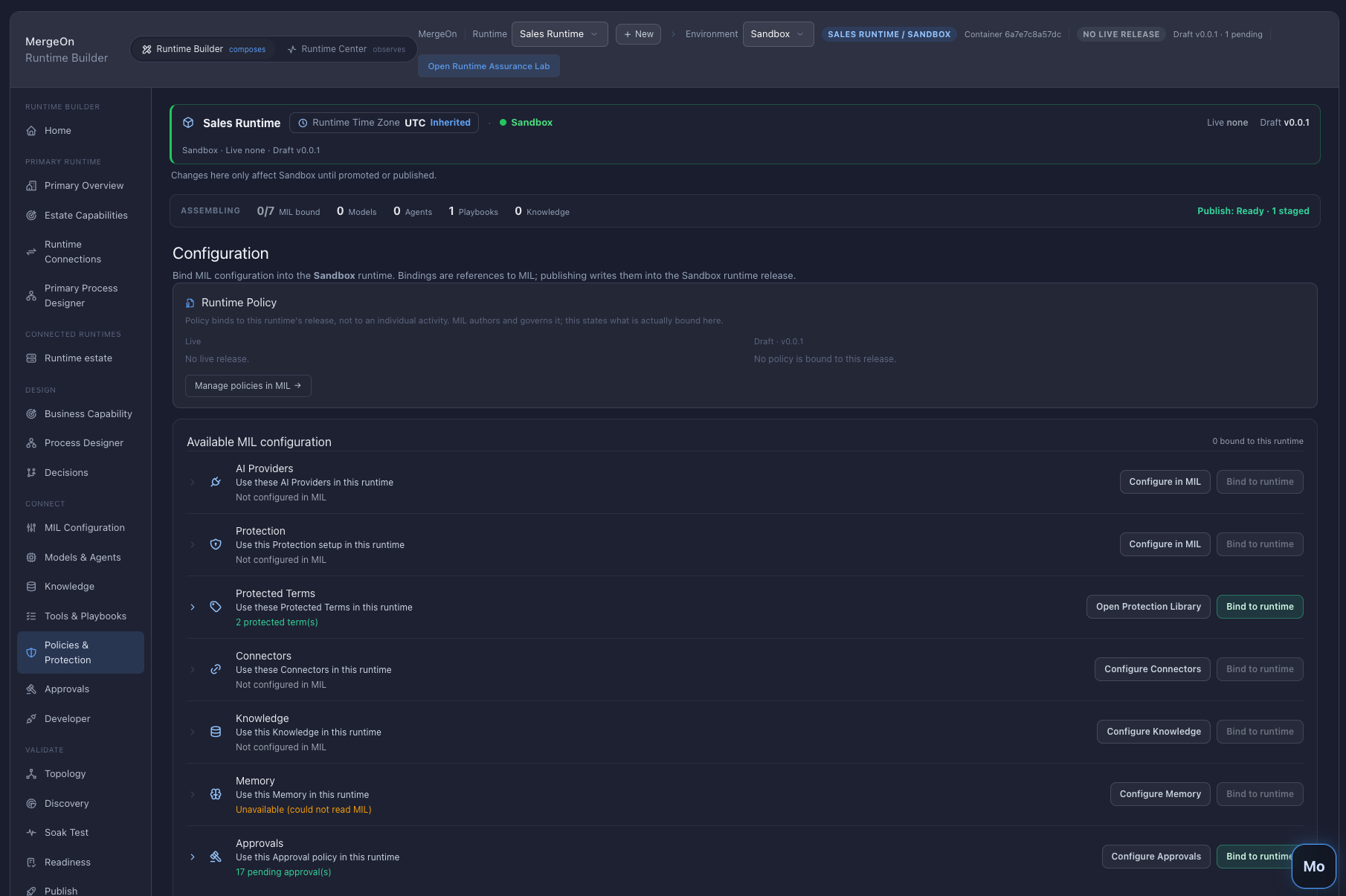
Define the controls that govern what AI may access, what it may do, what must be protected and when a person must approve. Bind those controls to governed activity so they are enforced at execution rather than left in documents.
The request does not decide what happens next.
AI can request an action. MergeOn determines whether the governed operation may proceed under the controls in force.
The participant requests an operation.
Evaluate the request against the policy, protection and approval requirements bound to the governed activity.
Allow, require approval, or refuse.
Only an admitted operation proceeds into governed execution.
The controls and decision in force form part of the execution record.
Written policy describes intent. Execution needs enforcement.
Policies, protection requirements and approval conditions become useful when they are bound to the activity that will execute and evaluated when that activity is invoked.
Define
Express the control that should govern the activity.
Bind
Attach the applicable policy, protection and approval requirements to the governed Runtime or activity.
Enforce
Evaluate the controls in force before the governed operation proceeds.
Control what may happen. Protect what must not be exposed.
Policy
Defines the conditions under which governed activity may proceed.
- Permitted activity
- Required conditions
- Approval requirements
- Operating constraints
Protection
Controls how protected information is handled within governed execution.
- Protected terms
- Sensitive information controls
- Applicable protection configuration
Some decisions should still belong to a person.
Where governed activity requires human authority, approval becomes an explicit condition of execution rather than an informal step outside the system.
What can govern an execution
Show what governed the operation — not just what the policy document said.
Execution evidence can identify the control context in force when the operation was evaluated, allowing the decision to be reconstructed from what actually happened.
Bind it, determine it, reconstruct it.
Runtime Builder
Bind the controls to the activity being composed.
Policy & Protection
Determine the applicable execution controls.
Golden Thread
Reconstruct the control context and execution evidence.
Move past the pilot.
Put your first governed AI activity into production.